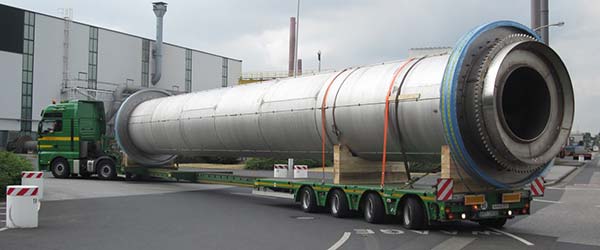
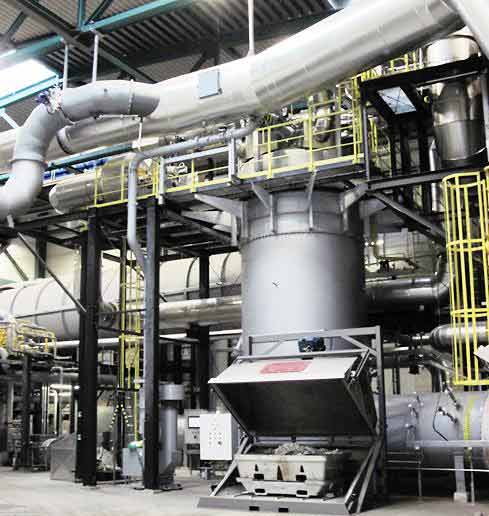
Rotary Kiln Delacquering Plants for thermal Recycling
Description of Rotary Kiln Delacquering Plants
Intended purpose of the rotary kiln delacquering plant is the delacquering and removal of organic compounds and contaminants from aluminium parts. The delacquered aluminium parts are fed into the melting furnace for recycling.
Examples for useable feedstock materials are used beverage cans (UBC), window profiles, parts from automotive industry, heat exchangers and other aluminium parts. The shredded material can come from the waste stream or from deposits, and consequently don’t need to be purchased from the production process or can cycle.
The delacquering includes organic compounds such as lacquers, stickers, etc..
The removal of contaminants includes contents residues, adhering parts such as dust, etc..
The delivered material, which shall be delacquered, is pre-treated depending on its condition in an upstream shredder and sorting plant which sorts-out foreign matter as well. Subsequently the feedstock material is transported to the delacquering plant.
In the delacquering plant, the feedstock material enters the rotary tube which is heated by hot flue gas. Due to the innovative process control different reaction zones within the rotary tube develop, by which the material is discharged from the rotary tube extensively free of lacquer und other stickers and in blank condition.
The delacquered material is transported to the melting furnace by means of the product conveyor system. In the melting furnace the delacquered material is melted down for liquid primary aluminium.
The process gas leaving the rotary tube is oxidised with process gas burners in the thermal post-combustion chamber. The thermal post-combustion chamber is equipped with a natural burner as well, which operates as pilot burner making sure that the flue gas temperature in the combustion chamber is kept at constant temperature.
A partial heat recovery occurs in the air preheater.
The flue gas is used as necessary for heating the rotary tube.
The remaining part of the flue gas enters the downstream arranged gas cleaning system.
New generation of Rotary Kiln Delacquering Plants:
- In Commissioning of the Rotary Kiln Delacquering Plant for the end-customer HYDRO ALUMINIUM in Neuss, HUTTER FREI POWER has carried out in different subject areas basic research and executed numerous trials.
- For this purpose, we have analytic measurements performed in the process gas and flue gas system. In a first phase by a University institute, in the second phase by a specialised measurement institute.
- The corresponding trial programs and the measurement scope have been specified by HUTTER FREI POWER. The attention was not only in normal operation but in operational disruptions as well, which are crucial for the explosion protection concept and the risk analysis.
- HUTTER FREI POWER analysed together with other involved parties the measurement results and gained important findings about the processes and interrelationships in the Delacquering Plant.
- HUTTER FREI POWER has equipped the Delacquering Plant with additional sensor systems and at critical sensor conditions, new measurement technologies have been tested and finally installed after the evaluations.
- The operating characteristics of approx. 2 years have been analysed systematically by HUTTER FREI POWER while being in intensive exchange with the plant operation. Thus, many interrelationships could be worked out, which were integrated in the plant operation as well.
- HUTTER FREI POWER has mainly further developed the explosion protection concept and adapted in collaboration with the explosion protection appraiser.
- With the operating experience and above mentioned findings and knowledge, HUTTER FREI POWER has further optimised the Delacquering Plant.
- Based on the above described findings and knowledge, HUTTER FREI POWER has developed a plant simulation model with taylor-made adapted components, which is applied at the project development, design and engineering of a project.
- The Rotary Kiln Delacquering Plant is based on the Rotary Kiln Delacquering Plant as optimised by HUTTER FREI POWER for HYDRO ALUMINIUM in Neuss, but HUTTER FREI POWER has further developed the Delacquering Plant in the following areas.
- Extension of the operating time between off-line cleaning outages to 6 months.
- Extension of the operating application range and the useable feedstock material qualities
- Optimised delacquering of the feedstock material by optimised guidance and control of the material flows and the parameter selection.
- Optimised process on the process gas side for the robust characteristics of unburned gas components in case of operational disruption.
- Adaptation of the explosion protection concept on above described changes
- Adaptation and improvement of the plant arrangement
- Feeding chute with double-flap lock chamber
- Rotary tube with e-drive
- Discharge chute with double-flap lock chamber
- Product discharge conveyor rotary tube – melting furnace with undersize separator
- Process gas fans
- Thermal post-combustion chamber with process gas burner and natural gas burner
- Air preheater LuVo with cooling air fan
- Ducts and flaps
- Hot air stack and safety stack
- Dust discharge
- Sensor systems
- Process control system with operation, observation, notification, archiving
- LV switch gear
- Steel structure and platforms
24 hours a day and 7 days a week
- Expected operating time between off-line cleaning outages:
- Expected availability without off-line cleaning outages:
- Recycling – Circular Economy – Raw Material Savings
- The recycling of aluminium in the melting furnace only needs about 5 % of the energy, which is necessary for the production of primary aluminium. Furthermore, about 85 % of the feedstock metal can be reused, which reduces as well the use of natural raw materials.
- The loss of primary aluminium in the melting furnace due to dross production is significantly reduced, because the organic compounds and contaminants at the feedstock material are almost completely removed in the Delacquering Plant.
- In comparison with other recycling technologies further fuel savings are achieved by the oxidation of the process gas and the integrated heat recovery.
- At full load the natural gas burner is controlled back to minimum load, which reduces the use of natural gas.
- The delacquered material is hot, which saves fuel in the melting furnace.
- Above advantages lead to correspondingly lower CO2 emissions and therefore lower CO2 costs.
- Low flue gas pollutant emissions by specially developed and controlled combustion in the thermal post-combustion chamber
- Use of feedstock material from waste stream and deposits is possible, which allows to keep the purchasing costs low.
- The operating time between off-line cleaning outages is approx. 6 months, by which the annual plant availability is correspondingly higher.
- The combustion of the process gases has been optimised with comprehensive analytic measurements. The unburned process gases are reduced to very low concentrations in the thermal post-combustion chamber.
- The operating range is extended down to 20 % of the nominal feedstock amount.
- The operating flexibility is increased with fast load changes of the feedstock amount.
- The process is based on a proven-in-use plant and is further developed by HUTTER FREI POWER based on comprehensive measurements, trials and findings.
- innovative process with further development based on proven-in-use plant
- integrated system design with consideration of specific customer requirements
- robust Design
- high-quality components with proven design
- selected redundancies
- strong focus on quality control from project start till hand-over
- The composition of the process gases is for the process mainly determined by the composition of the feedstock and different process parameters.
In any case there are saturated and unsaturated hydrocarbon compounds in the process gas, which are considered in the design of the combustion.
- Low pollutant emissions in the flue gas are achieved mainly by optimal combustion conditions of the process gas in the thermal post-combustion chamber.
- Measured concentrations in the flue gas after combustion chamber are as per external measurement institute as follows:
44 mg/Nm3 ref. to dry flue gas
< 5 mg/Nm3 ref. to dry flue gas