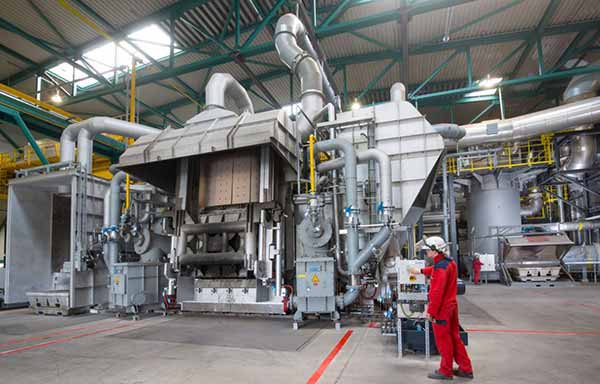
Rotary Kiln Delacquering Plants for thermal Recycling
Rotary Kiln Delacquering Plant UBC for HYDRO ALUMINIUM in Neuss
- Rotary Kiln Delacquering Plant for delacquering and removal of organic compounds and contaminants from used beverage cans (UBC) of aluminium, such as lacquers, stickers, contents residues, etc.
- The delacquering takes place in the rotary tube, which is heated by hot flue gas.
- The delacquered UBC material is led into the aluminium melting furnace for recycling.
- The process gas leaving the rotary tube is oxidised with process gas burners in the thermal post-combustion chamber (TPC).
- In the air preheater (LuVo) there is a partial heat recovery.
- The flue gas is used as necessary for heating the rotary tube.
The remaining part of the flue gas enters the downstream arranged gas cleaning system.
- The selected process represents in conjunction with UBC from the waste stream and the shredder and sorting plant a new development in the recycling of aluminium beverage cans.
- The delacquering includes organic compounds such as lacquers, stickers, etc..
The removal of contaminants includes contents residues, adhering parts such as dust, etc..
- The delivered material, which shall be delacquered, is pre-treated depending on its condition in an upstream shredder and sorting plant which sorts-out foreign matter as well. Subsequently the feedstock material is transported to the delacquering plant.
In the delacquering plant, the feedstock material enters the rotary tube which is heated by hot flue gas. Due to the innovative process control different reaction zones within the rotary tube develop, by which the material is discharged from the rotary tube extensively free of lacquer und other stickers and in blank condition.
The delacquered material is transported to the melting furnace by means of the product conveyor system. In the melting furnace the delacquered material is melted down for liquid primary aluminium.
- The process gas leaving the rotary tube is oxidised with process gas burners in the thermal post-combustion chamber. The thermal post-combustion chamber is equipped with a natural burner as well, which operates as pilot burner making sure that the flue gas temperature in the combustion chamber is kept at constant temperature.
A partial heat recovery occurs in the air preheater.The flue gas is used as necessary for heating the rotary tube.
The remaining part of the flue gas enters the downstream arranged gas cleaning system.
- Feeding chute with double-flap lock chamber
- Rotary tube with e-drive
- Discharge chute with double-flap lock chamber
- Product discharge conveyor rotary tube – melting furnace with undersize separator
- Process gas fans
- Thermal post-combustion chamber with process gas burner and natural gas burner
- Air preheater LuVo with cooling air fan
- Ducts and flaps
- Hot air stack
- Dust discharge
- Sensor systems
- Process control system with operation, observation, notification, archiving
- LV switch gear
- Steel structure and platforms
Feedstock / Material composition:
UBC material from waste stream / deposits
- Dust ref. to dry condition:
Further Feedstock UBC characteristics:
Throughput rate of wet feedstock UBC:
24 hours a day and 7 days a week
Expected availability without off-line cleaning:
- Recycling – Circular Economy – Raw Material Savings
- The recycling of aluminium in the melting furnace only needs about 5 % of the energy, which is necessary for the production of primary aluminium. Furthermore, about 85 % of the feedstock metal can be reused, which reduces as well the use of natural raw materials.
- The loss of primary aluminium in the melting furnace due to dross production is significantly reduced, because the organic compounds and contaminants at the feedstock material are almost completely removed in the Delacquering Plant.
- In comparison with other recycling technologies further fuel savings are achieved by the oxidation of the process gas and the integrated heat recovery.
- At full load the natural gas burner is controlled back to minimum load, which reduces the use of natural gas.
- The delacquered material is hot, which saves fuel in the melting furnace.
- Above advantages lead to correspondingly lower CO2 emissions and therefore lower CO2 costs.
- Low flue gas pollutant emissions by specially developed and controlled combustion in the thermal post-combustion chamber
- Use of feedstock material from waste stream and deposit sites is possible, which allows to keep the purchasing costs low.
- The combustion of the process gases has been optimised with comprehensive analytic measurements. The unburned process gases are reduce to very low concentrations in the thermal post-combustion chamber.
- The operating range is extended down to 20 % of the nominal feedstock amount.
- The operating flexibility is increased with fast load changes of the feedstock amount.
- The plant has been optimized by HUTTER FREI POWER based on comprehensive measurements, trials and findings.
- The composition of the process gases is for the process mainly determined by the composition of the feedstock and different process parameters.
In any case there are saturated and unsaturated hydrocarbon compounds in the process gas, which are considered in the design of the combustion.
- Low pollutant emissions in the flue gas are achieved mainly by optimal combustion conditions of the process gas in the thermal post-combustion chamber.
- Measured concentrations in the flue gas after combustion chamber are as per external measurement institute as follows:
44 mg/Nm3 ref. to dry flue gas
< 5 mg/Nm3 ref. to dry flue gas
- Planning, Engineering, Design, Delivery, Erection and Commissioning of a complete Rotary Kiln Delacquering Plant with thermal post-combustion chamber, natural gas burner, air preheater, fans, ducts, piping and valves, instrumentation, electrical systems with LV switchgear, distributed control system, steel structure and platforms.
HUTTER FREI POWER Scope of Services:
- Within the context of a restructuring, the company VSH, subsidiary of the company VOLKER WESSELS, has contracted the company HUTTER FREI POWER (HFP) for the further project execution with project management, process engineering, mechanical engineering, commissioning management and commissioning. Until the first operation, HUTTER FREI POWER identified and executed numerous modifications and improvements. With the first operating experiences the explosion concept has been further developed as well. For this detailled measurements have been executed and evaluated by University and measurement institutes and together with the company HYDRO ALUMINIUM as end-customer. The clarifications with the explosion protection appraiser have led at first to the release of the operation with a UBC mass flow of 4 t/h.
- In August 2016 it has been agreed between the contract parties, that the company HYDRO ALUMINIUM can use the support services of the company HUTTER FREI POWER as well. This contract includes for the delacquering plant the training of the operating personnel, analysis of the operating results, support to the operating engineers, participation at the joint task force and support at future plant modifications.
- In the dual contractor role, further trials have been executed on the supplier-side for the collection and development of fundamentals. The plant modifications, derived from the trial evaluations, have led to the release of the plant full load by the explosions protection appraiser. Furthermore remaining points have been worked-off and after the highly reliable two-week trial run with an availability of 98 %, the contractual hand-over could be achieved. In the role on the operator side, we have supported at various optimisations, the superintendent commissioning management executed, the operating characteristic further analysed and instructions prepared for the operation. Since September 2017, the delacquering plant can be operated continuously with the full UBC mass flow.
- VSH (current TrappInfra Services), Wesel, Germany
- HYDRO ALUMINIUM Rolled Products, Neuss, Germany